Material#
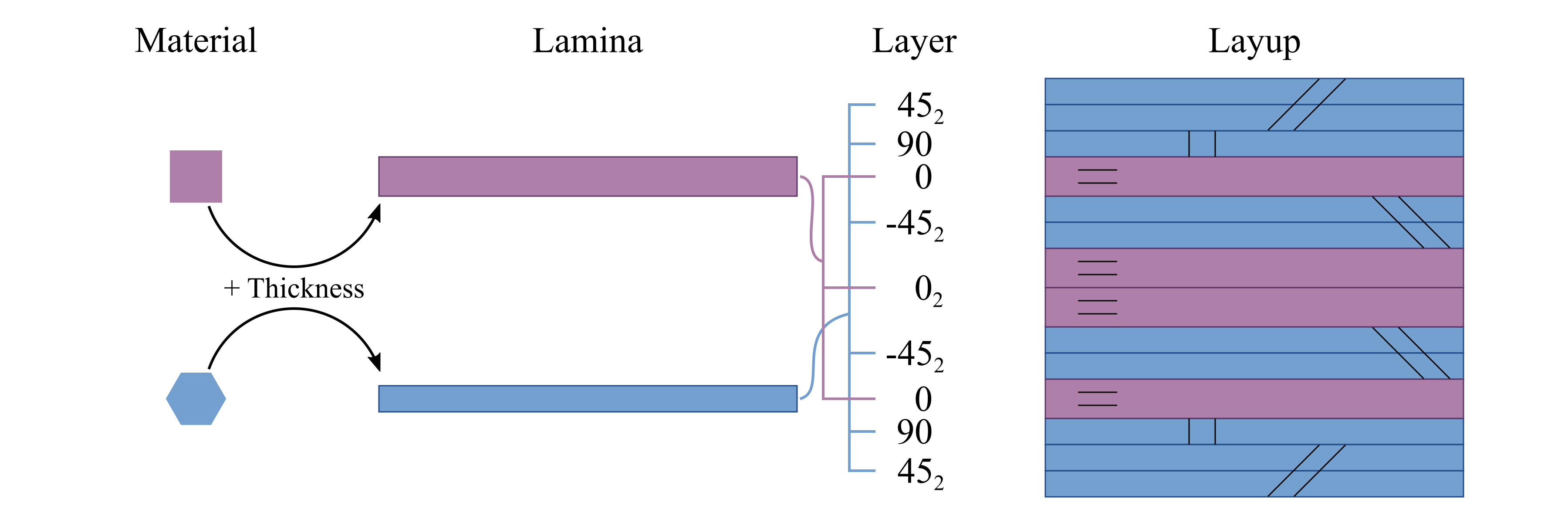
PreVABS uses the keyword material for the physical properties attached to any materials, while lamina for material plus thickness, which in a sense is fixed by manufacturers.
This can be thought as the basic commercially available “material”, such as a composite preprag.
A layer is a stack of laminae with the same fiber orientation.
The thickness of a layer can only be a multiplier of the lamina thickness.
Layup is several layers stacked together in a specific order.
This relationship is illustrated as:
Both materials and laminae are stored in one XML file (or directly in the main cross-section file under a <materials> block).
Each material must have a name and type. Under each <material> element, there are a <density> element and an <elastic> element.
If failure analysis is wanted, users need to provide extra data including <strength> and <failure_criterion>.
A template of this file is shown below:
<materials>
  ...
  <material name="..." type="...">
    <density>...</density>
    <elastic>...</elastic>
    <strength>...</strength>
    <failure_criterion>...</failure_criterion>
  </material>
  ...
</materials>
Specification
<material>Root element for each material.
nameName of the material.
typeMaterial symmetry class. Choose one from
isotropic,transversely isotropic,orthotropic(aliasengineering), andanisotropic.<density>Density of the material. Default is 1.0.
<elastic>Elastic properties of the material. Specifications are different for different types.
<strength>Strength properties of the material. Specifications are different for different types and different failure criterion.
<failure_criterion>Failure criterion of the material. Options are different for different types.
Note
Note
type="lamina" is no longer accepted as a material symmetry type.
Use type="transversely isotropic" for a material with transverse isotropy (the four engineering constants \(E_1\), \(E_2\), \(\nu_{12}\), \(G_{12}\) are required, the rest are derived as described below).
The <lamina> element is now used only to bind a material to a thickness, see the Lamina section.