Airfoil (MH-104)#
Baseline MH-104 airfoil example.
Overview#
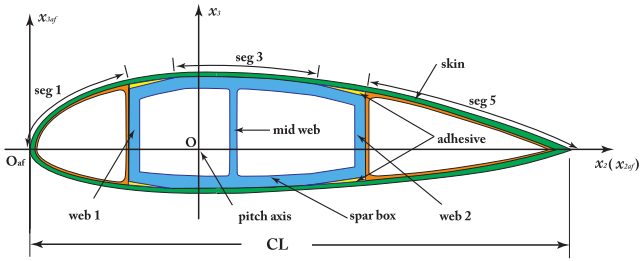
Figure 31 Sketch of a cross-section for a typical wind turbine blade [CHEN2010].#
This example demonstrates the capability of building a cross-section having an airfoil shape, which is commonly seen on wind turbine blades or helicopter rotor blades. This example is also studied in [CHEN2010]. A sketch of a cross-section for a typical wind turbine blade is shown in Figure 31. The airfoil is MH 104. In this example, the chord length \(CL=1.9\) m. The origin O is set to the point at 1/4 of the chord. Twist angle \(\theta\) is \(0^\circ\). There are two webs, whose right boundaries are at the 16.1% and 51.1% of the chord, respectively. Both low pressure and high pressure surfaces have four segments. The dividing points between segments are listed in Dividing points. Materials are given in Material properties and layups are given in Layups.
Between segments |
Low pressure surface |
High pressure surface |
|---|---|---|
\((x, y)\) |
\((x, y)\) |
|
1 and 2 |
(0.004053940, 0.011734800) |
(0.006824530, -0.009881650) |
2 and 3 |
(0.114739930, 0.074571970) |
(0.126956710, -0.047620490) |
3 and 4 |
(0.536615950, 0.070226120) |
(0.542952100, -0.044437080) |
Name |
Type |
Density |
\(E_{1}\) |
\(E_{2}\) |
\(E_{3}\) |
\(G_{12}\) |
\(G_{13}\) |
\(G_{23}\) |
\(\nu_{12}\) |
\(\nu_{13}\) |
\(\nu_{23}\) |
|---|---|---|---|---|---|---|---|---|---|---|---|
\(10^3\ \mathrm{kg/m^3}\) |
\(\mathrm{GPa}\) |
\(\mathrm{GPa}\) |
\(\mathrm{GPa}\) |
\(\mathrm{GPa}\) |
\(\mathrm{GPa}\) |
\(\mathrm{GPa}\) |
|||||
Uni-directional FRP |
orthotropic |
1.86 |
37.00 |
9.00 |
9.00 |
4.00 |
4.00 |
4.00 |
0.28 |
0.28 |
0.28 |
Double-bias FRP |
orthotropic |
1.83 |
10.30 |
10.30 |
10.30 |
8.00 |
8.00 |
8.00 |
0.30 |
0.30 |
0.30 |
Gelcoat |
orthotropic |
1.83 |
1e-8 |
1e-8 |
1e-8 |
1e-9 |
1e-9 |
1e-9 |
0.30 |
0.30 |
0.30 |
Nexus |
orthotropic |
1.664 |
10.30 |
10.30 |
10.30 |
8.00 |
8.00 |
8.00 |
0.30 |
0.30 |
0.30 |
Balsa |
orthotropic |
0.128 |
0.01 |
0.01 |
0.01 |
2e-4 |
2e-4 |
2e-4 |
0.30 |
0.30 |
0.30 |
Name |
Layer |
Material |
Ply thickness |
Orientation |
Number of plies |
|---|---|---|---|---|---|
\(\mathrm{m}\) |
\(\circ\) |
||||
layup_1 |
1 |
Gelcoat |
0.000381 |
0 |
1 |
2 |
Nexus |
0.00051 |
0 |
1 |
|
3 |
Double-bias FRP |
0.00053 |
20 |
18 |
|
layup_2 |
1 |
Gelcoat |
0.000381 |
0 |
1 |
2 |
Nexus |
0.00051 |
0 |
1 |
|
3 |
Double-bias FRP |
0.00053 |
20 |
33 |
|
layup_3 |
1 |
Gelcoat |
0.000381 |
0 |
1 |
2 |
Nexus |
0.00051 |
0 |
1 |
|
3 |
Double-bias FRP |
0.00053 |
20 |
17 |
|
4 |
Uni-directional FRP |
0.00053 |
30 |
38 |
|
5 |
Balsa |
0.003125 |
0 |
1 |
|
6 |
Uni-directional FRP |
0.00053 |
30 |
37 |
|
7 |
Double-bias FRP |
0.00053 |
20 |
16 |
|
layup_4 |
1 |
Gelcoat |
0.000381 |
0 |
1 |
2 |
Nexus |
0.00051 |
0 |
1 |
|
3 |
Double-bias FRP |
0.00053 |
20 |
17 |
|
4 |
Balsa |
0.003125 |
0 |
1 |
|
5 |
Double-bias FRP |
0.00053 |
0 |
16 |
|
layup_web |
1 |
Uni-directional FRP |
0.00053 |
0 |
38 |
2 |
Balsa |
0.003125 |
0 |
1 |
|
3 |
Uni-directional FRP |
0.00053 |
0 |
38 |

Figure 32 Base points of the tube cross-section.#

Figure 33 Base lines of the tube cross-section.#
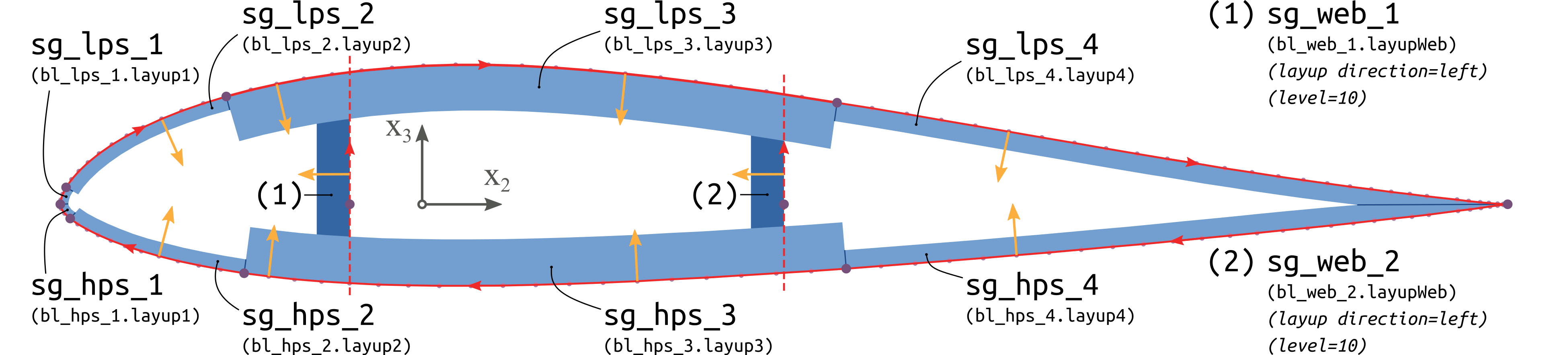
Figure 34 Segments of the tube cross-section.#
Input#
Run the example#
prevabs -i mh104.xml --hm
Output#
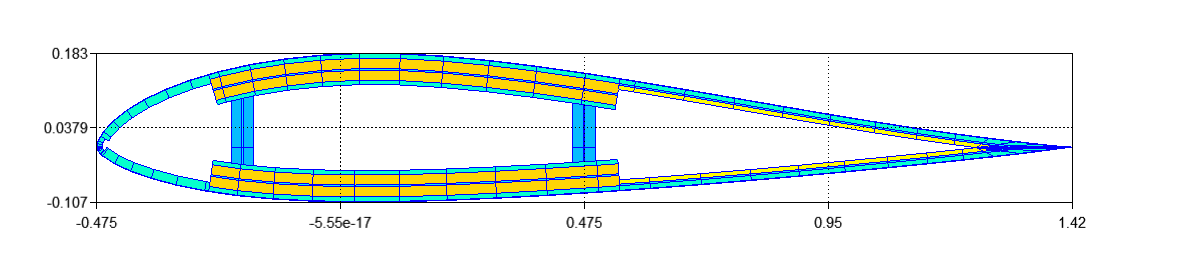
Figure 35 Cross-section viewed in gmsh.#
mh104.png
Analysis Result#
\(\phantom{-}2.395\times 10^9\) |
\(\phantom{-}1.588\times 10^6\) |
\(\phantom{-}7.215\times 10^6\) |
\(-3.358\times 10^7\) |
\(\phantom{-}6.993\times 10^7\) |
\(-5.556\times 10^8\) |
\(\phantom{-}1.588\times 10^6\) |
\(\phantom{-}4.307\times 10^8\) |
\(-3.609\times 10^6\) |
\(-1.777\times 10^7\) |
\(\phantom{-}1.507\times 10^7\) |
\(\phantom{-}2.652\times 10^5\) |
\(\phantom{-}7.215\times 10^6\) |
\(-3.609\times 10^6\) |
\(\phantom{-}2.828\times 10^7\) |
\(\phantom{-}8.440\times 10^5\) |
\(\phantom{-}2.983\times 10^5\) |
\(-5.260\times 10^6\) |
\(-3.358\times 10^7\) |
\(-1.777\times 10^7\) |
\(\phantom{-}8.440\times 10^5\) |
\(\phantom{-}2.236\times 10^7\) |
\(-2.024\times 10^6\) |
\(\phantom{-}2.202\times 10^6\) |
\(\phantom{-}6.993\times 10^7\) |
\(\phantom{-}1.507\times 10^7\) |
\(\phantom{-}2.983\times 10^5\) |
\(-2.024\times 10^6\) |
\(\phantom{-}2.144\times 10^7\) |
\(-9.137\times 10^6\) |
\(-5.556\times 10^8\) |
\(\phantom{-}2.652\times 10^5\) |
\(-5.260\times 10^6\) |
\(\phantom{-}2.202\times 10^6\) |
\(-9.137\times 10^6\) |
\(\phantom{-}4.823\times 10^8\) |
\(\phantom{-}2.389\times 10^9\) |
\(\phantom{-}1.524\times 10^6\) |
\(\phantom{-}6.734\times 10^6\) |
\(-3.382\times 10^7\) |
\(-2.627\times 10^7\) |
\(-4.736\times 10^8\) |
\(\phantom{-}1.524\times 10^6\) |
\(\phantom{-}4.334\times 10^8\) |
\(-3.741\times 10^6\) |
\(-2.935\times 10^5\) |
\(\phantom{-}1.527\times 10^7\) |
\(\phantom{-}3.835\times 10^5\) |
\(\phantom{-}6.734\times 10^6\) |
\(-3.741\times 10^6\) |
\(\phantom{-}2.743\times 10^7\) |
\(-4.592\times 10^4\) |
\(-6.869\times 10^2\) |
\(-4.742\times 10^6\) |
\(-3.382\times 10^7\) |
\(-2.935\times 10^5\) |
\(-4.592\times 10^4\) |
\(\phantom{-}2.167\times 10^7\) |
\(-6.279\times 10^4\) |
\(\phantom{-}1.430\times 10^6\) |
\(-2.627\times 10^7\) |
\(\phantom{-}1.527\times 10^7\) |
\(-6.869\times 10^2\) |
\(-6.279\times 10^4\) |
\(\phantom{-}1.970\times 10^7\) |
\(\phantom{-}1.209\times 10^7\) |
\(-4.736\times 10^8\) |
\(\phantom{-}3.835\times 10^5\) |
\(-4.742\times 10^6\) |
\(\phantom{-}1.430\times 10^6\) |
\(\phantom{-}1.209\times 10^7\) |
\(\phantom{-}4.406\times 10^8\) |
Note
The errors between the result and the reference are caused by the difference of modeling of the trailing edge. If reduce the trailing edge skin to a single thin layer, then the difference between the trailing edge shapes is minimized, and the two resulting stiffness matrices are basically the same, as shown in Figure 36.
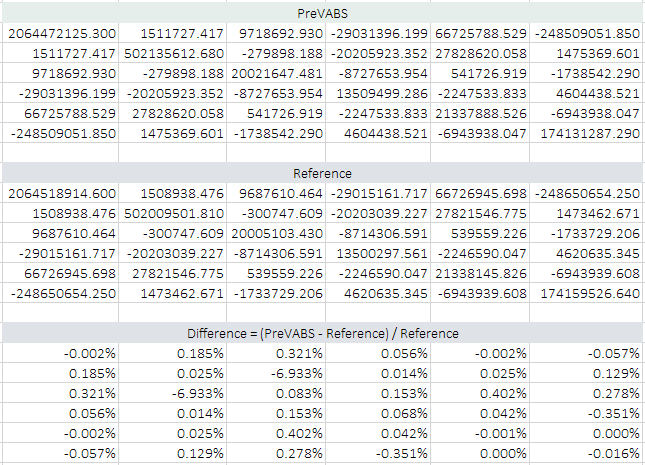
Figure 36 Comparison of stiffness matrices after modifying the trailing edge.#